A water tank technical submittal should let the engineer verify the tank’s capacity, materials, dimensions, supports, connections, equipment interfaces, testing and installation responsibilities. A brochure alone is not enough. The approval package should connect the tank data sheet to drawings, calculations, certificates, inspection records and the project specification.
Quick answer: A complete water tank technical submittal normally includes a compliance statement, data sheet, general arrangement, panel or shell details, support and foundation interfaces, connection schedule, design calculations where required, material information, testing plan, installation method and operation and maintenance documents.
This checklist is intended for owners, EPC contractors, MEP engineers, consultants and procurement teams reviewing sectional, stainless steel, GRP/FRP or integrated tank-and-pump proposals.
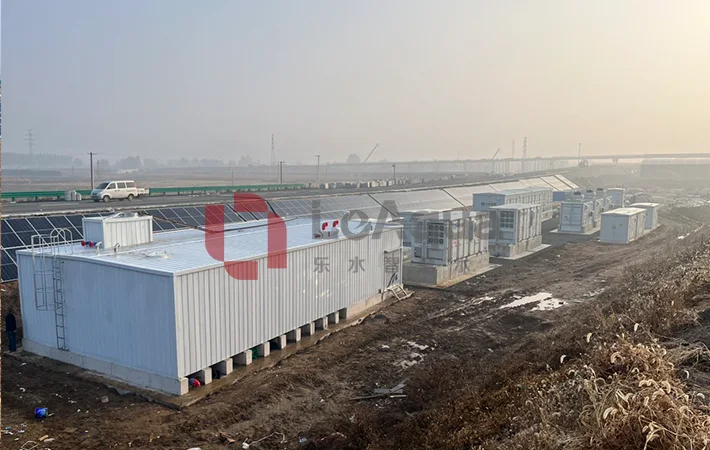
Review the submittal in the right order
The fastest way to find a problem is to review the package in layers. Start with scope and project inputs, then verify the tank geometry and interfaces, and only then review certificates and supporting records.
Layer 1: Scope and compliance
Confirm what the supplier is offering and what is excluded. The cover sheet should identify the project, tank service, capacity basis, material, construction method, applicable specification and document revision.
Look for a clear response to:
- Is the quoted capacity nominal or effective?
- Is the tank tank-only, or does the scope include pumps, controls and pipework?
- Is installation included, supervised or excluded?
- Who designs the foundation, anchors, support steel and pipe supports?
- Which items are optional, provisional or dependent on site information?
- Which standards are being used, and where do local project requirements take priority?
The water tank RFQ checklist helps collect the input data before the submittal arrives. A good submittal should answer the same questions without forcing the reviewer to reconstruct the scope from a quotation and a product brochure.
Layer 2: Geometry and interfaces
Check the general arrangement before reading the product literature. Confirm length, width, height, water levels, compartments, roof, access hatches, vent, overflow, drain, inlet, outlet, ladder, sensors and pump connections.
The drawing should identify dimensions that affect the site:
- overall footprint and highest point;
- panel or shell module sizes;
- support points and base elevations;
- access and maintenance clearances;
- connection elevations and orientations;
- lifting, assembly and removal routes;
- equipment and control-panel locations;
- interfaces with walls, beams, slabs and pipework.
If a drawing only shows the tank outline, it is not ready for construction coordination. The approval team needs to see the interfaces that can change the foundation, roof, pipework or maintenance plan.
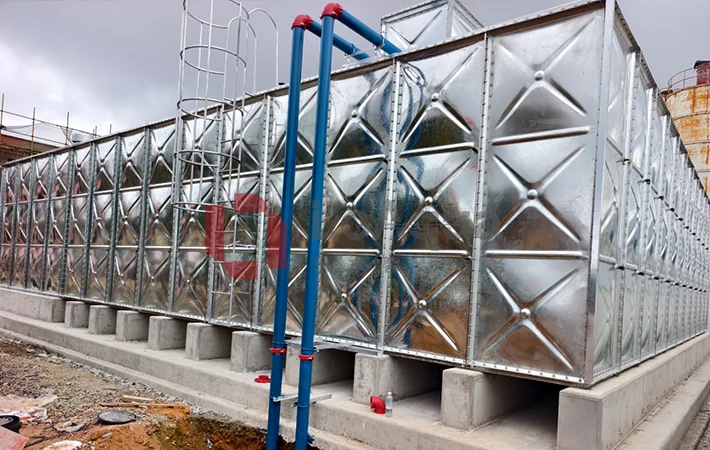
Core documents in a water tank technical submittal
1. Compliance and deviation statement
Ask the supplier to mark each project requirement as compliant, not applicable, pending confirmation or deviating. Deviations should be specific. “Standard product” does not explain a different material, connection, coating, gasket, support or test requirement.
The reviewer should be able to find:
- project specification clause or requirement;
- supplier response;
- supporting document or drawing number;
- deviation, assumption or exclusion;
- action owner and required decision date.
2. Tank data sheet
The data sheet should define service, dimensions, nominal capacity, effective capacity, operating levels, materials, construction method, weights and design conditions. If the tank is for potable water, the material and gasket information should be tied to the required local approval or contact-material criteria rather than a broad statement such as “food grade.”
If pumps or controls are included, list duty, standby arrangement, motor data, control philosophy, alarm points and electrical assumptions separately from the tank data. This prevents an integrated package from hiding missing tank information.
The nominal versus effective capacity article explains why the two capacity terms should not be used interchangeably.
3. General arrangement and detail drawings
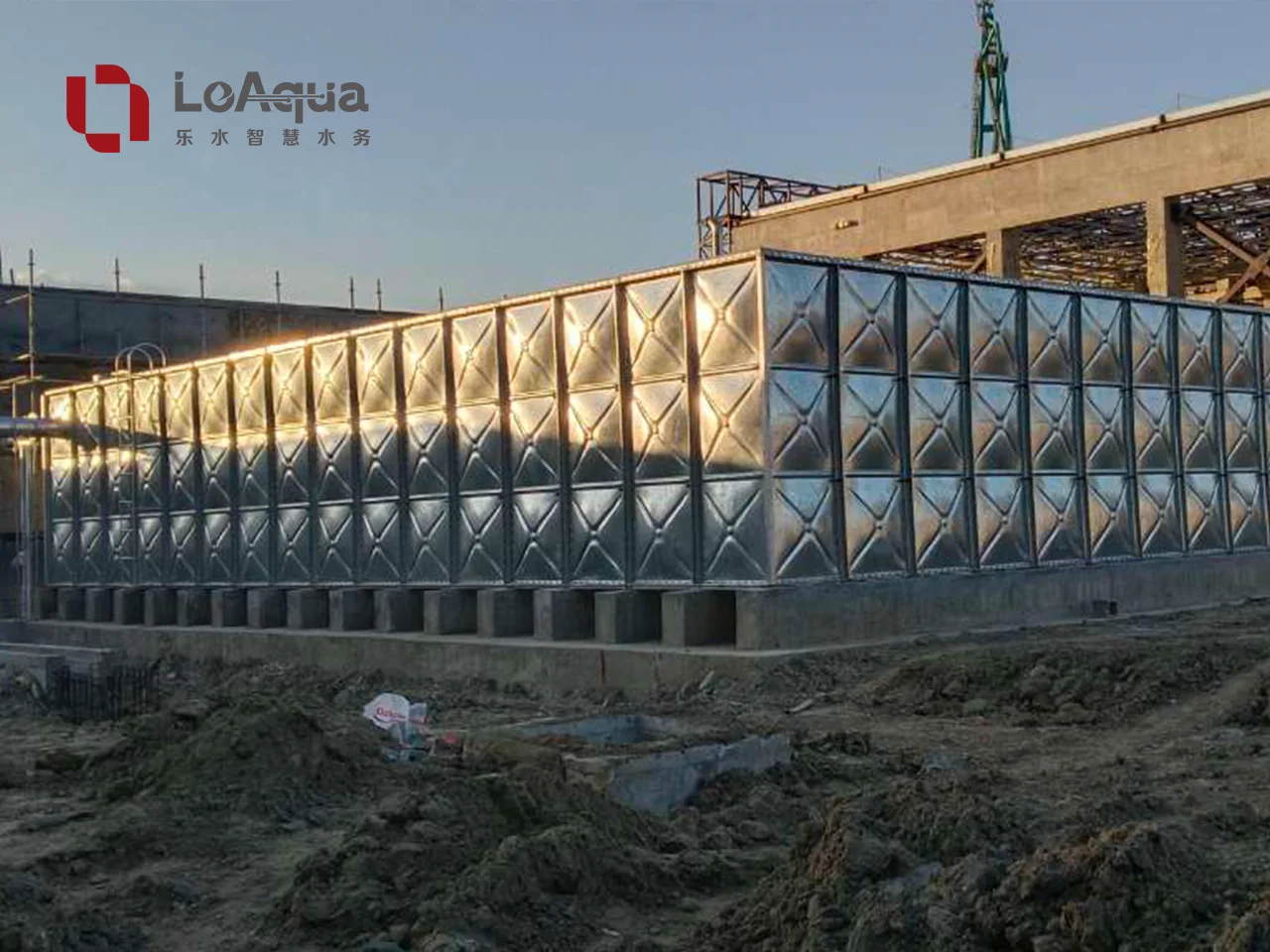
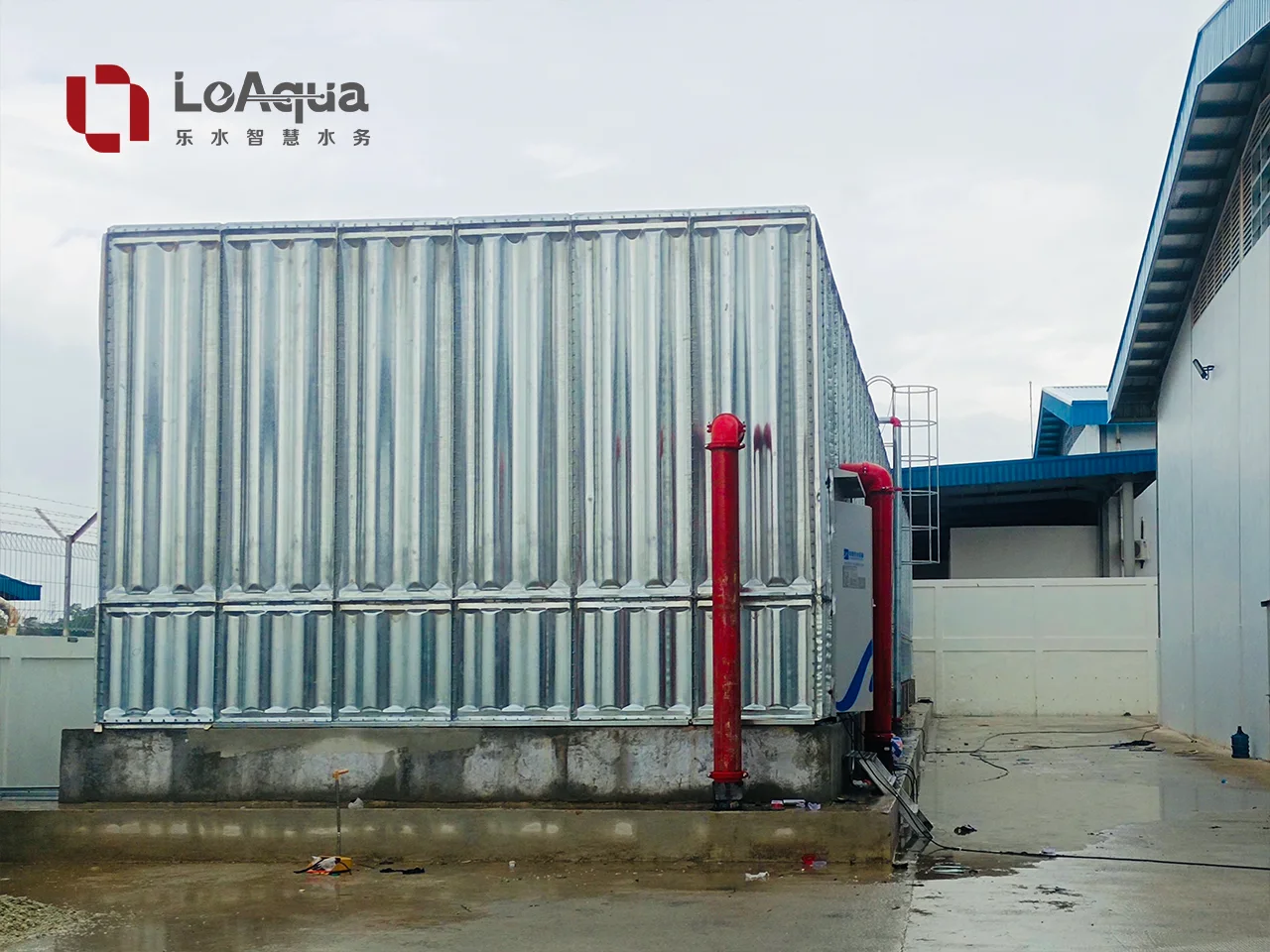
At minimum, request a general arrangement, base/support detail, connection schedule, roof/access detail and installation or assembly drawing. For a sectional tank, the panel layout, rib direction, joint arrangement, bolts, gaskets and stiffeners should be identifiable.
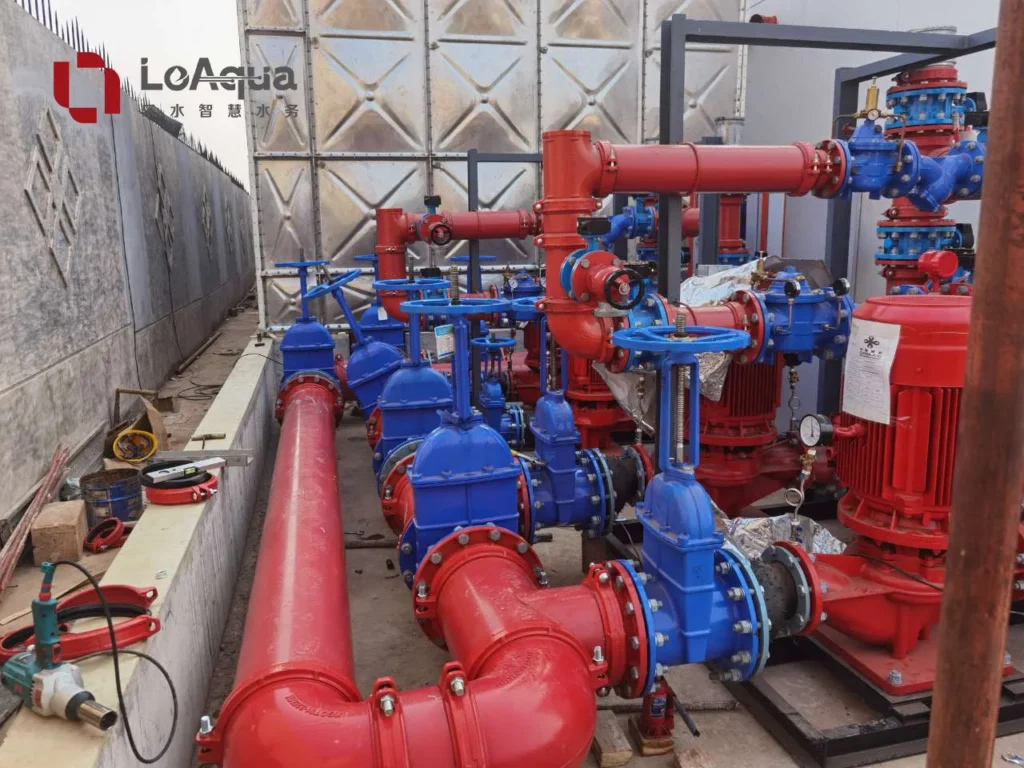
For an integrated pump system, add a pump skid or manifold layout, pipe support points, control cabinet arrangement and maintenance envelope. For a roof or seismic installation, include support reactions, anchors and movement assumptions.
4. Design calculations and reactions
The calculation requirement depends on the project and tank type. It may include capacity confirmation, hydrostatic pressure, panel or shell design, support reactions, wind, seismic, anchor forces, foundation loads, nozzle loads, pump hydraulics or overflow capacity.
Do not request “all calculations” without stating the approval purpose. Instead, identify which calculations the consultant needs to verify the tank and which calculations belong to the building or site engineer.
The submittal should state assumptions such as:
- full and partial operating levels;
- water density or process liquid properties;
- support and foundation conditions;
- wind and seismic criteria;
- pipe restraint and nozzle-load basis;
- corrosion allowance or environmental exposure;
- compartment and partition arrangement;
- applicable material and testing standards.
5. Materials and certificates
The package should identify the actual material for panels, flanges, bolts, gaskets, supports, coatings and wetted accessories. A certificate list is only useful when it can be matched to the supplied item, material grade, heat or batch reference where applicable, and project requirement.
For potable-water projects, verify the exact contact-material requirement and certificate holder. Management-system certificates or a general factory certificate do not automatically prove that every tank component is approved for drinking-water contact.
The potable water tank procurement checklist covers this distinction in more detail.
6. Testing and inspection plan
The inspection and test plan should state what is checked, when, by whom and against which acceptance criterion. Depending on the tank type and project, it may cover:
- incoming material verification;
- panel, weld, bolt or gasket inspection;
- dimensional and coating checks;
- leak or hydrostatic testing;
- pressure testing of connected pipework;
- pump performance or control testing;
- cleaning and disinfection;
- site installation inspection;
- punch-list closure and final acceptance.
WBDG UFGS 01 33 00 submittal procedures identify drawings, descriptive literature, test reports, O&M manuals, certifications and warranties as document types that may be required for approval. The exact document set will vary by contract, but the principle is useful: link each test and certificate to a specific part of the installed system.
7. Installation method and site responsibilities
The method statement should explain sequence, tools, lifting, panel handling, joint preparation, torque or welding controls, sealant, alignment, temporary protection and testing. It should also identify the party responsible for scaffolding, lifting equipment, foundation readiness, electrical connections, pipe supports and final cleaning.
For overseas projects, include packing, container unloading, site storage and access restrictions. The shipping sectional water tanks article can be used as a logistics reference, but the project submittal should still state the actual delivery and installation assumptions.
8. Operation and maintenance information
The O&M section should match the equipment actually supplied. Include normal operation, inspection points, screen and vent checks, gasket or seal replacement, level-control settings, pump maintenance, spare parts, cleaning, disinfection and emergency isolation.
The water tank handover documents article explains why as-built drawings, test records and O&M manuals should be prepared as a controlled document set, not gathered as loose files after installation.
A practical review table
| Review item | Evidence to request | Typical reviewer |
|---|---|---|
| Capacity and levels | Data sheet and level diagram | Process or MEP engineer |
| Footprint and access | General arrangement and clearance plan | Architect, MEP and site team |
| Base and reactions | Support detail and load schedule | Structural engineer |
| Connections | Nozzle/pipe schedule and flexible-interface detail | MEP engineer |
| Materials | Material schedule and traceable certificates | Consultant or QA/QC team |
| Testing | ITP, test forms and acceptance criteria | QA/QC and commissioning team |
| Installation | Method statement and responsibility matrix | Main contractor and site engineer |
| Controls | Instrument list, alarm matrix and sequence | Controls engineer |
| Handover | As-builts, test records and O&M manuals | Owner and facilities team |
How to review drawings efficiently
Use one marked-up coordination drawing as the control document. Put the tank footprint, support points, connection elevations, access route, pipe anchors, vent, overflow and drain on the same view. Then compare the data sheet, calculation assumptions and quotation against that drawing.
When a revision is issued, record what changed. A changed panel height may affect capacity, roof clearance, ladder access, pipe elevations, foundation reactions and shipping dimensions. Treat those as linked changes rather than approving a revised PDF in isolation.
The reviewer should also check the document status: for approval, approved with comments, approved for construction, or information only. “Approved” without a status or revision can create confusion about whether fabrication may start.
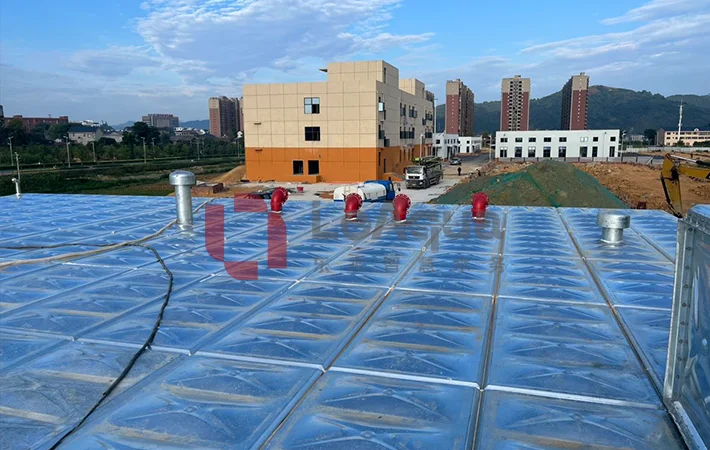
Common submittal problems
The brochure replaces the project drawing
A brochure describes a product family. It does not prove that the proposed dimensions, connections, accessories and supports fit the project.
The capacity is not defined
Nominal volume, geometric volume, working volume and effective volume may differ. The submittal should label the capacity used for the design and operation.
Certificates are listed without matching the supplied item
A certificate number without a material schedule, scope or holder is difficult to verify. Ask what item the certificate covers and whether it applies to the delivered component.
Structural responsibility is hidden
Tank reactions, anchors, support steel and concrete design can sit in different scopes. The submittal should make the boundary visible instead of leaving it to a site assumption.
Testing is promised but not defined
“Factory tested” or “tested before delivery” is not an acceptance criterion. State the test, medium, duration, record and responsible witness.
How LeAqua can support the submittal process
LeAqua can organize a project-specific package around the requested tank material, capacity, dimensions, connections, foundation information and pump requirements. A useful submission should help the consultant answer three questions: does the tank fit the project, can the interfaces be built, and can the installed system be tested and handed over with traceable records?
The final approval still belongs to the project consultant, owner or authority identified in the contract. LeAqua should provide the tank-specific information and clearly identify assumptions, exclusions and documents that will be issued after design inputs are confirmed.
Frequently asked questions
Is a water tank data sheet enough for approval?
Usually not. A data sheet confirms headline values, but approval normally also needs drawings, connection information, support interfaces, testing requirements and material or certificate information appropriate to the project.
Should shop drawings include the foundation?
They should show the tank-to-foundation interface and the reactions or assumptions needed by the structural engineer. The supplier may not design the entire concrete foundation unless that scope is explicitly included.
Do potable-water certificates prove the whole tank is compliant?
Not automatically. Verify the exact component, material, certificate holder, test scope and local authority requirement. A general ISO or factory certificate is not the same as a product-specific drinking-water contact approval.
When should the O&M manual be submitted?
The outline should be reviewed before installation so access, valves, controls and maintenance requirements can be coordinated. The final manual should include as-built information and test records after commissioning.
Reference material
- WBDG Unified Submittals
- WBDG UFGS 33 16 15 Water Storage Steel Tanks
- WBDG UFGS 01 33 00 Submittal Procedures
- WBDG VA 22 12 16 Facility Elevated, Potable-Water Storage Tanks
- US EPA Finished Water Storage Tank Inspection/Cleaning Checklist
Conclusion
A water tank technical submittal is a coordination package, not a brochure bundle. Review the scope, geometry, supports, connections, materials, calculations, testing and handover records as one controlled set. When assumptions and responsibilities are visible before fabrication, approval becomes faster and the risk of redesign at the foundation, pipework or commissioning stage is lower.