When a project team starts discussing a fire water tank, one of the first questions is often:
“How many cubic meters of water do we need?”
That is an important question, but it is not where the calculation starts.
Engineers first determine the fire protection demand, then consider how long that demand must be maintained and how the water will reach the system.
Only after these conditions are understood can the required tank capacity and fire pump duty be established.
The basic logic is:
Fire scenario → Required flow → Required duration → Storage requirement → Pump duty
This is why a fire water tank and fire pump should be considered as parts of the same system rather than as separate products.
1. Start With the Fire Scenario
The first step is to establish what the fire water system is expected to protect.
Depending on the project, the water supply may serve:
- Fire hydrants
- Hose stations
- Automatic sprinklers
- Water spray systems
- Other water-based suppression systems
Engineers also need to determine which systems are expected to operate simultaneously under the design fire scenario.
This matters because the required flow is based on the actual fire protection design, not simply the largest flow rate appearing in a product catalogue.
For projects using NFPA-based designs, the applicable standards may include NFPA 22 for private fire protection water tanks, NFPA 20 for stationary fire pumps, and NFPA 24 for private fire service mains.
The exact requirements still depend on the project specification, applicable edition and local authority.
2. Determine Required Fire Flow and Duration
Once the fire scenario is established, engineers determine the required water flow.
Depending on the project, this may include:
- Sprinkler demand
- Hydrant demand
- Hose stream demand
- Water spray demand
The next question is how long the water supply must remain available.
At a basic level:
Required fire water volume = Required flow × Required duration
This relationship is simple, but the actual flow and duration must come from the applicable fire protection design.
For example, two projects can have the same fire pump flow but require different storage capacities because their required operating durations are different.
This is why there is no universal rule such as:
“A project with this building size needs a tank of this volume.”
The storage requirement needs to be calculated from the actual fire protection scenario.
3. Check the Effective Fire Water Volume
One of the most common mistakes in tank comparison is assuming that the geometric tank volume is the same as the usable fire water volume.
For example, a tank may have a nominal volume of 500 m³, but the project may have additional requirements involving:
- Minimum operating level
- Freeboard
- Pump suction level
- Reserve volume
- Inlet and outlet arrangement
The design team therefore needs to confirm how much water is actually available for the fire protection system.
This distinction is important when comparing supplier quotations.
A quotation that says:
500 m³ stainless steel water tank
does not, by itself, explain the actual usable fire water volume.
For general water storage capacity selection, see 【How Engineers Select Water Tank Capacity for Different Applications】
4. Check the Existing Water Supply
A dedicated fire water tank does not always need to provide the entire fire demand.
Engineers first check whether an existing water source can reliably provide part of the required flow.
This may include:
- Municipal water
- Private water supply
- Dedicated reservoirs
- Other approved sources
Important questions include:
- What flow is available?
- What pressure is available?
- Is the supply reliable during an emergency?
- Can it provide water for the required duration?
This becomes particularly important for remote renewable energy projects.
A wind farm or solar plant may have limited access to municipal infrastructure, making dedicated fire water storage more important.
See the related application guides:
【How to Select a Fire Water Tank for a Battery Energy Storage System (BESS)】
【How to Select a Fire Water Tank for a Solar Power Plant】
【How to Plan Fire Water Storage for a Wind Farm】
5. Calculate Pump Flow and Head
Once the fire water demand is known, engineers can determine the required fire pump operating point.
Pump selection involves at least two important parameters:
Flow
How much water must the pump deliver?
Head
What pressure must the pump provide to move that water through the system and maintain the required pressure at the point of demand?
Pump head may include:
- Static elevation
- Pipe friction losses
- Fittings and valves
- Required residual pressure
For a simple building, the hydraulic calculation may be relatively straightforward.
For a large site, however, the distribution network can be much more complicated.
A wind farm may have long distances between the tank and hydrants.
A solar plant may have widely distributed electrical equipment.
A high-rise building may have significant elevation differences.
The same fire water volume can therefore require very different pump arrangements.
This is why engineers should select the pump based on the system duty point, not simply its maximum catalogue flow.
For more discussion of storage and pumping together, see 【Water Tank With Pump System 】.
6. Tank and Pump Should Be Designed Together
This is where many equipment-based approaches become inefficient.
A tank supplier may focus on:
How much water can the tank store?
A pump supplier may focus on:
What flow and head can the pump provide?
The project, however, needs both answers to be correct at the same time.
Consider two projects with the same 500 m³ fire water tank and the same nominal pump flow.
If one project has a short distribution network and the other has a long network with significant elevation and pipe losses, the required pump head and system arrangement may be very different.
The tank volume has not changed.
The fire water demand may not have changed.
But the hydraulic system has changed.
This is why storage and pumping should be reviewed together before equipment is finalized.
7. Consider Duty, Standby and Controls
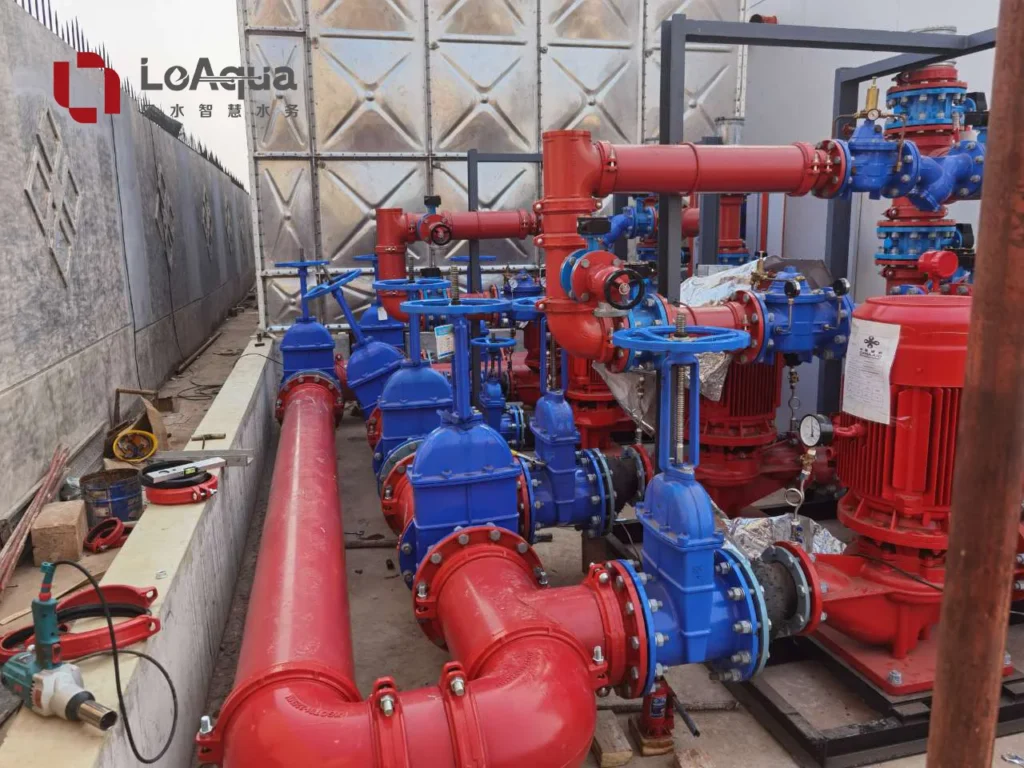
Fire water systems often require more than one pump.
Depending on the project, the arrangement may include:
- Main fire pump
- Standby fire pump
- Jockey pump
- Emergency or alternative power supply
The exact configuration depends on the applicable standard and project requirements.
Engineers should also review:
- Automatic pump starting
- Pressure monitoring
- Alarm functions
- Power availability
- Pump status monitoring
A standby pump only provides value if the system can start and operate it correctly when needed.
This is why controls and monitoring should be considered together with the mechanical equipment.
A Practical Fire Water Calculation Workflow
For many projects, the engineering process can be summarized as:
1. Define the fire scenario
↓
2. Determine required fire flow
↓
3. Determine required duration
↓
4. Establish required usable storage
↓
5. Check available external water supply
↓
6. Calculate pump flow and head
↓
7. Verify pipework and pressure
↓
8. Select tank, pumps and controls as one system
This workflow is more reliable than starting with a standard tank size and trying to fit the fire protection system around it.
Common Mistakes to Avoid
Choosing Tank Capacity From Building Size Alone
Building area does not directly determine the fire water requirement.
Choosing a Pump From Flow Alone
The pump also needs to provide the required head at the actual operating point.
Treating Nominal Volume as Usable Fire Water
Tank dimensions and effective fire water volume are not always identical.
Ignoring Pipe Losses
Long pipe runs can significantly affect pump head.
Selecting Tank and Pump Independently
The two systems need to satisfy the same fire protection design basis.
Why This Matters for Integrated Water Supply Solutions
Once the calculations are complete, the project can move from individual equipment selection to system design.
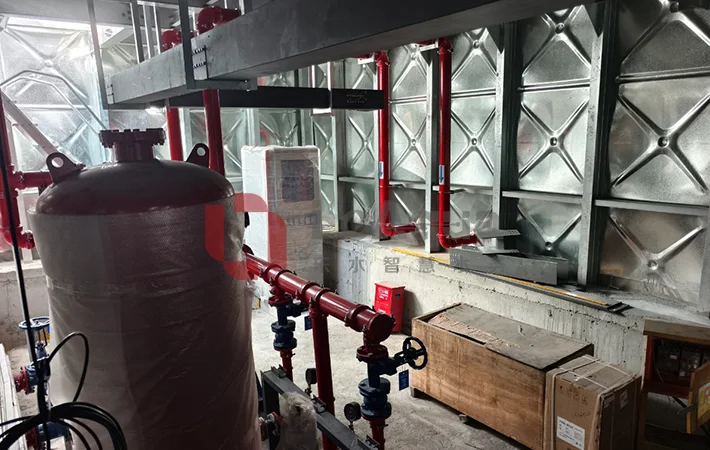
A complete fire water solution may include:
- Water storage tank
- Fire pumps
- Valves and pipework
- Control cabinet
- Monitoring equipment
For projects where storage and pumping need to be considered together, a water tank with pump system can provide a more coordinated approach.
For larger integrated projects, the same engineering process can extend to an integrated pump station combining storage, pumping, control and monitoring.
The important point is not whether the project uses one supplier or several.
It is whether the engineering logic remains consistent from the initial fire demand calculation to the final equipment selection.
Final Thoughts
Fire water tank capacity and pump flow should be calculated from the fire protection system requirements rather than selected from a standard equipment catalogue.
The key sequence is:
Fire scenario → Flow → Duration → Usable storage → Pump duty point → Hydraulic verification
The actual calculation remains project-specific.
Local codes, fire authority requirements, water sources, site conditions and system configuration all need to be reviewed before equipment is ordered.
A fire water tank provides the reserve.
The pump system delivers it.
The control system coordinates operation.
Monitoring provides information about system status.
When these elements are considered together, the result is a complete fire water supply system rather than a collection of individual products.