When a project team evaluates fire protection systems, water mist and sprinkler systems are often considered for the same facility. However, they are not interchangeable solutions.
The right choice depends on the fire risk, enclosure, fuel type, water supply, ventilation, approval requirements, maintenance plan and project budget. A system should not be selected simply because it uses less water or appears more compact.
What Is the Difference Between Water Mist and Sprinkler Systems?
A sprinkler system controls fire by discharging water through sprinkler heads when heat activates them. A water mist system uses specially designed nozzles to produce much finer droplets, which can absorb heat and help control fire conditions within a protected space.
Water mist is not automatically better than sprinklers. It is a different fire protection approach that may be more suitable for certain risks, spaces or project constraints.
Water Mist vs Sprinklers: Main Differences
| Factor | Water Mist System | Sprinkler System |
|---|---|---|
| Droplet size | Uses fine water droplets | Uses larger water discharge |
| Water demand | May reduce water demand in some designs | Usually requires a larger water supply |
| Space requirements | Can be useful where pipework or water storage space is limited | Requires sprinkler piping and suitable water storage |
| Fire control mechanism | Cooling, heat absorption and local fire control | Cooling and wetting of the burning area |
| Design dependence | Highly dependent on nozzle, enclosure and fire scenario | Often based on established sprinkler design methods |
| Project approval | Requires application-specific validation and approval | Widely recognized, but still subject to local requirements |
| Maintenance | Requires nozzle, pump and control inspection | Requires sprinkler, valve, pump and pipe inspection |
The comparison is general. Actual performance depends on the system design, listed components, installation quality and fire scenario.
When Should a Project Consider Water Mist?
A water mist system may be worth evaluating when a project has one or more of the following conditions:
- Limited space for water storage or pipework
- Sensitive equipment that could be affected by large amounts of water
- Enclosed technical areas
- Heritage or archive environments
- Data centers or electrical rooms
- Tunnels, machinery spaces or industrial equipment areas
- A requirement to control fire while limiting water usage
These applications still require a proper fire risk assessment. Water mist is not suitable for every fuel type or every room layout.
Ventilation is particularly important. Air movement can affect how mist droplets travel and whether they remain effective in the protected zone. Nozzle spacing, obstruction, ceiling height and enclosure volume must be reviewed during system design.
When Are Sprinkler Systems Often More Practical?
Sprinkler systems may be a practical choice when:
- The building has a conventional commercial or industrial layout
- A reliable water supply is already available
- Local contractors are experienced with sprinkler installation
- The project follows a familiar sprinkler design route
- The owner wants a widely recognized fire protection method
- The fire risk is well suited to sprinkler protection
Sprinklers are commonly used in commercial buildings, warehouses, factories, residential buildings and other facilities. They are not a simple or maintenance-free solution, but their design and installation processes are familiar in many markets.
The availability of local service personnel can also influence the decision. A technically suitable system may become difficult to operate if local teams cannot inspect, test or repair it properly.
Five Checks Before Selecting a Fire Suppression System
1. Identify the fire scenario
Start with the actual fire risk rather than the equipment name.
Review:
- Fuel type
- Expected fire size
- Equipment arrangement
- Room volume
- Ceiling height
- Ventilation
- Potential obstructions
- Fire growth characteristics
A system designed for an archive, a data center and a warehouse may require very different protection strategies.
2. Review water supply and hydraulics
The project team should confirm:
- Required flow
- Pump pressure
- Water storage capacity
- Discharge duration
- Pipe routing
- Pump room or equipment space
- Backup power requirements
Water mist may reduce water demand in some applications, but this should be demonstrated through the approved system design. It should never be assumed from the term “mist” alone.
3. Confirm the approval route
The applicable standard depends on the project, location and fire risk.
For reference, the NFPA 13 standard covers sprinkler systems, while NFPA 750 addresses water mist fire protection systems.
These standards are not interchangeable checklists. The project engineer and Authority Having Jurisdiction should confirm the applicable edition, testing requirements, system listing and approval route.
LeAqua also maintains an engineering standards and technical references page for project teams reviewing technical documentation.
4. Compare installation conditions
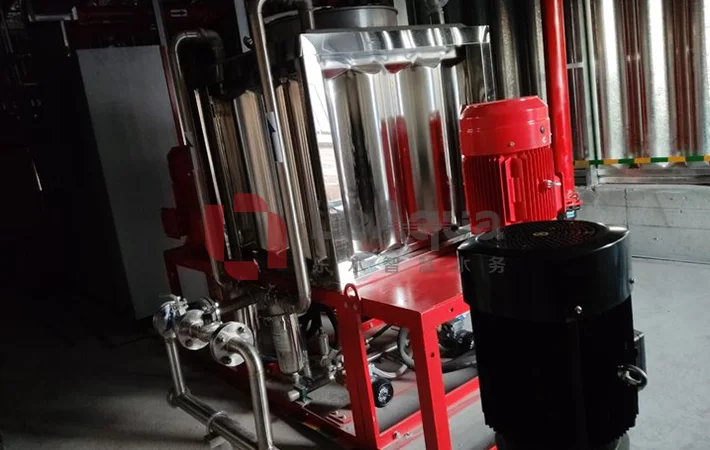
A water mist system may require high-pressure pumps, specialized nozzles, control equipment and careful commissioning.
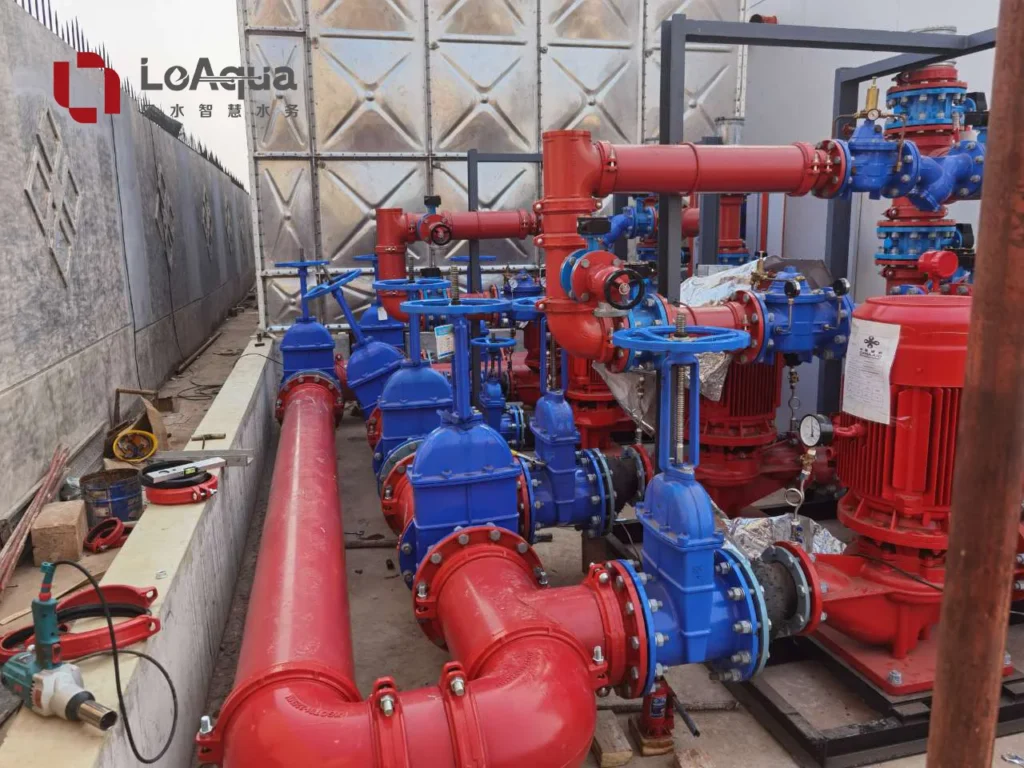
A sprinkler system may require larger pipework, valves, water storage and more extensive distribution piping.
The design should consider:
- Delivery access
- Available installation space
- Construction sequence
- Local labor capability
- Equipment lifting
- Commissioning responsibility
- Future inspection access
5. Plan long-term maintenance
A fire protection system is only useful if it remains ready for operation.
The maintenance plan should cover:
- Pump testing
- Nozzle or sprinkler inspection
- Valve condition
- Alarm and control functions
- Water quality where relevant
- Backup power
- Drainage and leakage
- Periodic system testing
The owner should understand who will provide service after installation and whether replacement components are available locally.
How LeAqua Supports Water Mist Projects
LeAqua provides high-pressure water mist fire suppression systems for project-specific applications.
The relevant configuration may include high-pressure pumps, control equipment, piping, nozzles and monitoring functions. The final design should be based on the protected space, fire risk, required performance, local approval conditions and maintenance resources.
You can review the LeAqua High-Pressure Water Mist System page for the product category and visit the project case library for related water supply and fire protection applications.
Frequently Asked Questions
Is water mist better than sprinklers?
No single system is better for every project. Water mist may be suitable for certain enclosed or water-sensitive applications, while sprinklers may be more practical for conventional commercial, industrial or residential buildings.
Does water mist always use less water?
No. Water demand depends on the system design, fire scenario, protection duration, nozzle arrangement and approval requirements. A lower water volume should be verified through hydraulic calculations and project documentation.
Can water mist replace sprinklers in every building?
No. Replacement depends on the fire risk, enclosure, system approval, local regulations and the acceptance of the project authority. Water mist should be selected as an engineered system, not as a universal substitute.
Final Recommendation
Choose between water mist and sprinklers by starting with the fire risk, not the equipment label.
Water mist may be appropriate where space, water usage, sensitive equipment or enclosed technical areas are important considerations. Sprinklers may be more practical where the building has conventional layouts, established local contractors and a familiar approval route.
For a project-specific recommendation, provide the protected application, room dimensions, fire risk, required duration, available water supply and project country to the LeAqua engineering team.