Water mist nozzle selection is a system design decision. The correct nozzle depends on the fire hazard, enclosure, design pressure, flow, spray pattern, mounting position, obstructions, water quality and approval basis. A nozzle that performs well in one tested arrangement cannot automatically be transferred to another room, ceiling height or fuel type.
This guide is written for fire protection engineers, EPC contractors, system integrators and project buyers who need to prepare a water mist specification. It explains the questions to answer before comparing nozzle catalogs and shows how the nozzle must be coordinated with the pump, tank, filtration, detection and control package.
Quick answer: Select a water mist nozzle whose documented test scope and design limitations match the intended hazard, then confirm the required project acceptance. Confirm the hazard, nozzle type, minimum operating pressure, flow, spray pattern, spacing, obstruction limits, water quality and control sequence together. Size the pump and usable tank storage from the documented hydraulic demand and required operating duration.
Why Water Mist Nozzle Selection Cannot Be Separated from the System
A water mist system does not create protection through the nozzle alone. The nozzle, pipe network, pump, water supply, detection logic and protected enclosure must work as one arrangement. UL Solutions identifies specialized nozzles, high-pressure pumps, control systems, pipes and detection or activation mechanisms as critical water mist system components.
This is also why a general “coverage area per nozzle” number can be misleading. Water mist performance is influenced by droplet formation, discharge momentum, heat release, ventilation, ceiling height, obstructions and the location of the fuel. The final spacing must come from the approved design manual, fire test evidence or the applicable project standard.
NFPA 750, Standard on Water Mist Fire Protection Systems, addresses design, installation, maintenance and testing requirements. It is an important reference when a project specifies NFPA-based design. Identify the edition adopted for the project, the applicable local requirements and the evidence supporting the selected system. Citing NFPA 750 is not evidence that a particular nozzle or pump has a product certification.
| Design question | Why it changes nozzle selection |
|---|---|
| What is burning? | Solid combustibles, machinery oils, cable insulation and other fuels produce different fire behavior and require different tested arrangements. |
| Where is the fire? | Ceiling level, local equipment, cable trench, enclosed machinery or a room-wide hazard may require different discharge directions. |
| How does the system start? | Open nozzles with detection, closed heat-responsive nozzles and pre-action arrangements do not use the same control sequence. |
| What pressure and flow are available? | The nozzle spray pattern and droplet characteristics are tied to the approved operating range, not only to the pump nameplate. |
| What approval route applies? | Separate the adopted design standard, product test or certification requirements, local authority conditions and insurer requirements. These are different parts of the acceptance basis. |
1. Start with the Protected Hazard, Not the Nozzle Catalogue
The first step in water mist nozzle selection is to define the hazard and the protection objective. Ask whether the system is intended for room protection, local application, equipment cooling, exposure protection or a combination of objectives. A nozzle that is suitable for suppressing a fire in an enclosed machine may not be suitable for a high-ceiling storage space or an outdoor transformer.
Record the fuel, expected fire size, enclosure dimensions, ceiling height, ventilation rate, openings, obstructions, operating temperature and whether people remain in the space during discharge. For equipment protection, record the equipment envelope, oil inventory, cable routes, hot surfaces and areas where spray may be blocked.
Record the scope of the supporting fire tests, including fuel, enclosure, ventilation, mounting height and operating conditions. A result for one arrangement does not establish suitability for every occupancy or justify replacing sprinkler protection in another project.
2. Confirm the Nozzle Type and Actuation Arrangement
Water mist nozzles are not interchangeable simply because they have the same connection size. The design team should first confirm the nozzle family and the way it is actuated.
Open nozzles
Open nozzles discharge when a zone valve opens. They are commonly used with a separate detection and release sequence. The design must define the detection logic, valve opening time, alarm interlocks, pump start and the number of nozzles that may operate at the same time.
Closed heat-responsive nozzles
Closed nozzles use a heat-responsive element. Only the nozzles exposed to the required temperature may open, depending on the system design. The temperature rating, response characteristics, orientation and spacing must match the approved arrangement.
Directional or local-application nozzles
Local-application nozzles are aimed at a defined piece of equipment or a specific hazard zone. Their performance depends strongly on distance, angle, line of sight and the presence of shields, guards or cable trays. A nozzle layout that looks correct on a plan may fail to wet the intended surface if equipment geometry is not checked in three dimensions.
Confirm that the specified nozzle and its actuation arrangement are included in the relevant system documentation. An open-nozzle zone and a heat-responsive closed-nozzle system require different discharge and control assumptions.
3. Match Pressure and Flow to the Approved Operating Window
Pressure and flow are the most visible nozzle data, but they are often used incorrectly. The minimum operating pressure, rated flow, maximum system pressure and hydraulic loss must be checked at the hydraulically most remote nozzle or at the location defined by the applicable test basis.
Do not select a pump by adding the flow rates printed on several unrelated nozzle data sheets. Determine the design operating area or the local application demand first, then calculate the simultaneous operating nozzles, pipe losses, elevation, valves, filters and safety margin required by the approved design.
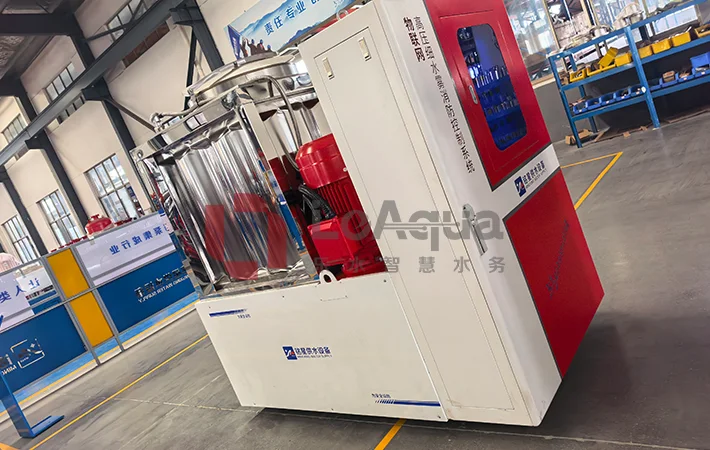
Model-specific reference: The Jiangsu Mingxing equipment documents reviewed for this guide give approximately 10 MPa as a nozzle working-pressure reference. Separately, Shanghai type-test report Zb24M5122302 records a working-pump test result of 14 MPa and 115 L/min for the main system model XSWBG 115/14 MX. These values describe different locations and evidence scopes; they are not a universal pressure range for LeAqua water mist systems.
A higher pump discharge pressure can allow for pipe friction, elevation, valves and filters before water reaches the nozzle. That is a possible engineering explanation for the difference between the reference values, not confirmation of a particular project design. Verify the exact nozzle’s permitted pressure range, pump duty and curve, component pressure ratings and hydraulic calculation. Do not use approximately 10 MPa as a universal minimum nozzle pressure or treat 14 MPa as an automatically correct duty for every system.
| Parameter | What to verify | Common mistake |
|---|---|---|
| Minimum nozzle pressure | Pressure at the most hydraulically unfavorable nozzle during the design discharge. | Using pump outlet pressure as if it were nozzle pressure. |
| Nozzle flow | Flow at the approved pressure and for the exact nozzle orifice and spray pattern. | Assuming two nozzles with the same thread size have the same flow. |
| Maximum pressure | Compatibility of the nozzle, fittings, valves and pipework with the system pressure. | Checking the pump only and ignoring the distribution components. |
| Hydraulic losses | Pipe length, elevation, bends, filters, control valves and fittings. | Using a short test-rig result for a long building network. |
| Operating duration | Water storage and pump duty for the approved hazard and discharge sequence. | Sizing the tank from instantaneous flow without duration. |
4. Check Spray Pattern, Droplet Behavior and Coverage
A water mist nozzle is selected for how it distributes water in a defined space, not for a small droplet claim in isolation. The spray angle, discharge direction, droplet distribution, momentum and interaction with hot gases all affect whether the mist reaches the fire and absorbs heat where it is needed.
For ceiling protection, check the ceiling height, beam depth, light fittings, cable trays, ducts and suspended services. For local application, check the distance from the nozzle to the protected equipment, the angle of impact and whether the spray can reach the sides, underside or rear of the hazard.
Request droplet and distribution data for the exact nozzle and test conditions. A quoted maximum droplet size, mean size or volumetric percentile describes a different measure; none should be used as a substitute for evidence of fire performance in the intended arrangement. This guide does not adopt the marketing claim of Dv0.99 ≤100 μm as a verified specification for every nozzle.
Engineering rule: Treat coverage as a tested arrangement of nozzle type, spacing, pressure, mounting height, enclosure and hazard. Do not transfer a spacing value from one application to another without checking the approval basis.
5. Treat Obstructions as a Performance Issue
Obstructions are one of the easiest ways to create a visually complete but technically weak nozzle layout. A deep beam, pipe rack, tray, machine guard, crane rail or suspended ceiling can interrupt the spray pattern or create a shadowed area.
Review the nozzle layout in plan, elevation and section. Mark every object that can block the spray. For local application, include doors, access panels and removable covers in both their open and closed positions if the hazard can operate in either state.
Check each obstruction against the selected system’s installation limitations and fire-test arrangement. Additional nozzles below or around an obstruction must follow the documented design basis; adding a nozzle without reassessing flow and coverage can change the hydraulic demand.
If the layout cannot maintain the required discharge pattern, the options may include additional nozzles, a change in orientation, a different nozzle family, a separate local application zone or a different protection concept. The answer should come from the system designer and approval documents, not from a generic rule of thumb.
6. Coordinate Nozzles with Water Quality and Filtration
Fine water passages and small nozzle orifices make filtration and maintenance part of the nozzle decision. Suspended solids, scale, corrosion products or debris can restrict the filter, alter flow or affect the discharge pattern.
Before specifying the nozzle, record the water source, storage condition, water analysis, pipe material, treatment method and expected temperature range. Confirm whether the nozzle manufacturer specifies a strainer, filter rating, flushing arrangement or water-quality limit. The filter must be accessible for inspection and cleaning, and the system should provide a clear way to identify a blocked or bypassed filter.
The Mingxing operating manual reviewed for LeAqua identifies a filter as part of the water mist equipment and requires routine checks of pump operation, filter clogging and pipeline pressure stability. Its product material also states that the referenced nozzle filter opening should be limited in relation to the smallest nozzle waterway opening. Because this is model-specific information, the exact ratio and filter arrangement must be taken from the selected product manual.
LeAqua’s high-pressure water mist water supply guide discusses the tank, filtration, make-up pump, pressure stabilization pump and high-pressure main pump as a coordinated package. That coordination matters because nozzle reliability depends on the whole water path.
7. Check Materials, Corrosion and Maintenance Access
Nozzle material should suit the water chemistry, ambient conditions, installation location and required service life. Stainless steel may be appropriate for many water mist arrangements, but material selection still needs to consider chloride exposure, coastal air, cleaning chemicals, dissimilar-metal contact and temperature.
Maintenance access is equally important. A nozzle hidden above a fixed ceiling may be difficult to inspect, replace or clean. If a nozzle has a protective cap, filter, bulb, actuator or anti-drip device, the project documents should explain how it is inspected and what condition requires replacement.
Include space to inspect, test, remove and replace the equipment in the layout. Follow the manufacturer’s maintenance instructions and the project’s adopted standard, and keep inspection and replacement records for the installed models.
8. Understand the Approval and Documentation Boundary
“Tested nozzle” and “approved system” are not interchangeable descriptions. A nozzle may be tested for a defined pressure range or component standard while the complete system is approved only for certain hazards, layouts or operating conditions.
Before procurement, request the documents that define the design boundary:
- nozzle data sheet with model, orifice, connection, material, pressure range and flow;
- spray pattern or distribution data for the relevant mounting orientation;
- system design, installation, operation and maintenance manual;
- fire test or approval information identifying the hazard and limitations;
- hydraulic calculation method and simultaneous discharge condition;
- filter, strainer and water-quality requirements;
- control sequence for detection, valves, pump start, alarms and shutdown;
- commissioning, acceptance testing and maintenance requirements.
Where NFPA 750 Fits—and What a Test Report Proves
NFPA 750 provides a system design and installation framework when it is specified or adopted for the project. Product testing and certification are separate evidence. For example, UL Solutions describes NFPA 750 as the installation standard and lists separate testing standards for water mist equipment. This reference explains the distinction; it does not indicate that LeAqua or Mingxing equipment is UL certified.
The local Shanghai type-test reports reviewed for this guide, Zb24M5122302 and Zb24M5122303, name Jiangsu Mingxing Water Supply Equipment Co., Ltd. as the producer. They cover the listed XSWBG and XSWBGB models, respectively, and state that the inspected items meet XF 1149-2014, with an overall pass conclusion. They also reference the Chinese fire-product certification implementation rules. A test report’s reference to those rules is not a substitute for a valid product certificate.
Evidence boundary: These reports support the reported results for the identified samples and test scope. They do not establish NFPA, UL, FM or VdS certification, cover every site layout, or demonstrate acceptance in every export market. The copies were reviewed for this guide; independent verification in the issuing institution’s records and current certificate status have not been completed. Confirm the exact supplied model, report scope and project acceptance requirements before procurement.
How LeAqua Can Support the Water Mist Nozzle Selection Process
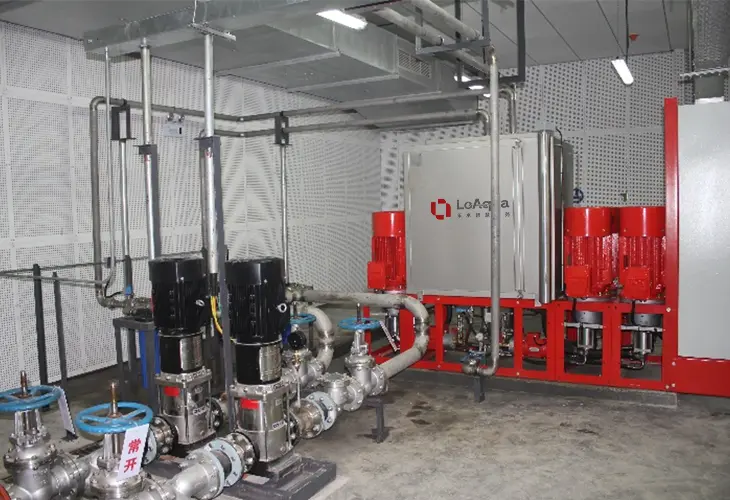
LeAqua can discuss the nozzle as part of a coordinated water mist package that includes the water tank, filtration, high-pressure pump, pressure stabilization or make-up pump, control cabinet, valves and monitoring instruments. This is useful when the project team wants the interfaces checked together instead of purchasing a nozzle separately from an unrelated pump package.
LeAqua’s High Pressure Water Mist System page provides the product context, while the water mist commissioning guide covers the checks needed before handover. For the wider water-supply scope, see the pump systems page and the water tank selection guide.
When requesting a proposal, send the protected hazard, room or equipment drawings, ceiling height, obstructions, fire scenario, system type, required approval route, water source, water quality, available power, ambient conditions, design pressure, expected flow, discharge duration and required documentation. LeAqua can then separate confirmed product information from project-dependent engineering assumptions.
Water Mist Nozzle Selection Checklist
| Item | Ready when… |
|---|---|
| Hazard definition | The fuel, fire scenario, protection objective and enclosure are documented. |
| Nozzle type | Open, closed, directional or local-application arrangement is identified. |
| Hydraulic basis | Minimum pressure, flow, simultaneous nozzles, losses and duration are calculated. |
| Layout | Plan, elevation and section drawings show spacing, orientation and obstructions. |
| Water path | Tank, filter, pump, valves, pipework and nozzle materials are compatible. |
| Controls | Detection, zone valve, pump start, alarm, interlock and reset sequences are defined. |
| Approval | The listing, test basis, authority requirements and insurer comments are recorded. |
| Maintenance | Inspection access, filter cleaning, nozzle replacement and spare parts are planned. |
Common Water Mist Nozzle Selection Mistakes
- Choosing by thread size alone. Connection size does not define spray pattern, flow or approval.
- Using the maximum pump pressure as the nozzle design pressure. Pressure must be checked at the nozzle after system losses.
- Copying a spacing value from another project. Water mist protection is application-specific and often test-based.
- Ignoring obstructions until installation. Beams, ducts and equipment can change the discharge pattern.
- Specifying a nozzle without a filtration plan. Small passages require an accessible and maintainable water-quality strategy.
- Assuming component certification equals system approval. The complete arrangement still needs the applicable design and acceptance basis.
- Leaving the tank and pump interface undefined. Water level, suction conditions, pressure control and alarms affect system readiness.
Conclusion: Select the Nozzle as Part of the Approved System
The right water mist nozzle is the one that matches the tested hazard, hydraulic design, spray geometry, water quality, control sequence and project approval route. The nozzle should be selected together with the pump, tank, filtration and pipework, then verified through the required design review and commissioning process.
For a project-specific proposal, send LeAqua the hazard description, drawings, nozzle layout constraints, pressure and flow requirements, water-source information and approval expectations. The engineering team can then review the water mist nozzle and water-supply package as one coordinated scope.
Frequently Asked Questions
Can any high-pressure nozzle be used in a water mist system?
No. The nozzle must be compatible with the system pressure, flow, spray pattern, materials, filtration and approval basis. A nozzle from another system should not be substituted without engineering review and documented acceptance.
Is a smaller droplet always better?
No. Droplet size is only one part of performance. The required discharge pattern, momentum, heat absorption, enclosure, fuel and ventilation determine whether the mist reaches and controls the hazard.
How many water mist nozzles are needed in a room?
The number depends on the approved spacing, ceiling height, obstructions, hazard and design pressure. Use the system design manual or hydraulic calculation rather than a generic area-per-nozzle estimate.
Does the nozzle determine the pump size?
The nozzle is one of the inputs. Pump duty also depends on simultaneous discharge, pipe losses, elevation, filters, valves, pressure reserve and required operating duration.
What information should be included in a water mist nozzle RFQ?
Include the hazard, drawings, room dimensions, ceiling height, obstructions, system type, nozzle arrangement, design pressure and flow, water quality, power supply, required approvals and documentation. This gives the supplier enough information to separate a product quotation from a project design assumption.
Does citing NFPA 750 mean a water mist nozzle is certified?
No. NFPA 750 is a standard for water mist systems. A claim of product certification requires separate evidence identifying the certifier, standard, exact model and scope. A Chinese type-test report should be assessed within its own stated standard and test scope; it does not establish NFPA, UL, FM or VdS certification.