Can water mist extinguish a transformer fire? Yes—water mist can extinguish certain fires involving oil-immersed transformers when the system has been tested and designed for that fire scenario. The important distinction is between burning oil outside the transformer and an electrical fault inside it. A fire suppression system addresses the fire; it does not repair the fault.
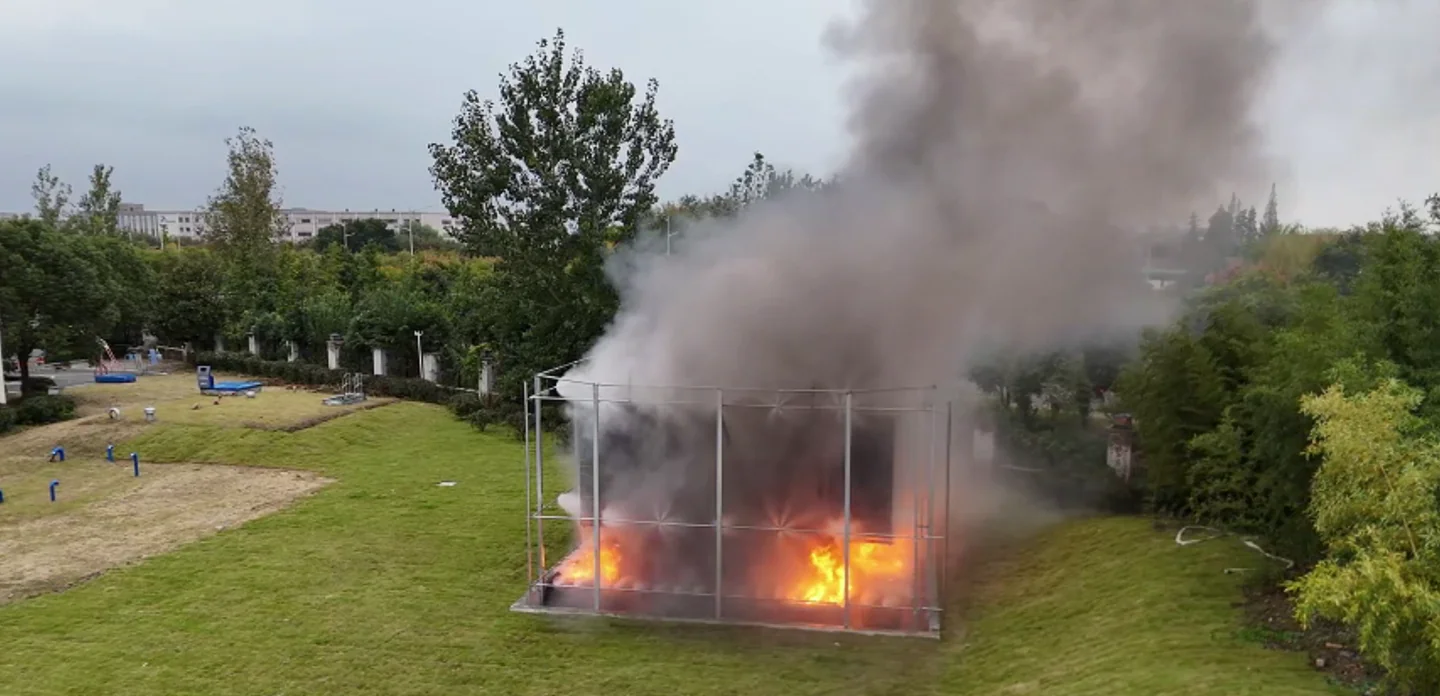
The transformer fire-test footage reviewed for this article makes that distinction easier to understand. It shows a transformer test assembly surrounded by nozzle pipework, with an oil-fire arrangement at its base. The spray reaches the lower fire area and the space around the equipment. Later in the edited sequence, visible flames diminish substantially.
For an EPC contractor or substation owner, the useful question is not simply whether a high-pressure water mist system works. It is whether the tested arrangement represents the transformer, oil-fire exposure and site conditions being specified.
What the transformer fire test actually shows
The footage includes daytime and nighttime sequences. The pipework is arranged around the equipment at different heights, with coverage directed toward the upper assembly, main transformer body and lower oil-fire area. This is a useful illustration of why transformer protection is a three-dimensional problem, rather than a matter of placing one nozzle above a piece of equipment.
The most relevant observation is the relationship between the spray and the fire beneath and around the transformer. A system has to deliver water to those exposed fire zones despite the equipment standing in its path. A dense cloud beside the transformer is not, by itself, proof that the burning oil is receiving effective coverage.
The images support a discussion of layout and visible fire suppression. They do not establish the transformer’s energized condition, an independently verified extinguishing time or a certification. The film is edited, so its playback length should not be used as a stopwatch for system performance.
Why water mist can suppress a transformer oil fire
Fine droplets absorb heat as they warm and evaporate. Water vapor produced in the hot fire region can also dilute oxygen locally. These are established water mist mechanisms, described in the Naval Research Laboratory paper on suppression mechanisms hosted by NIST. Their relative contribution depends on the fire and the way the spray reaches it.
For an outdoor transformer, this should not be described as removing oxygen from the whole substation. Wind and open surroundings make that a very different situation from a protected enclosure. The practical issue is what happens where the droplets interact with the flame and hot gases.
Water sprays can also reduce radiant heat transmission. Building Research Establishment experiments, available through NIST, demonstrate this effect and its dependence on spray characteristics. That does not establish a heat-shield rating for the system in this video. Protecting nearby equipment still requires a project-specific exposure assessment.
The appeal of water mist is the effective use of water where it is needed. Any claim about reduced tank size, lower total consumption or less damage needs a documented comparison for the same hazard and performance objective—not a general percentage applied to every transformer.
The difficult part is reaching the burning oil
Transformer geometry matters. Radiators, the tank body, support structures and surrounding barriers can interrupt a spray path. Oil at the base may be partly shielded from a nozzle that appears to cover the equipment well from above.
The multi-level arrangement visible in the footage is therefore worth studying. Upper and side coverage should not distract from the lower fire zone. Equally, the number of nozzles in a demonstration is not a design rule for another transformer. Changing nozzle position, pressure or equipment geometry can change the result.
This is why water mist nozzle selection has to be coordinated with the tested hazard, pipe network, pump and water supply. A nozzle catalog alone cannot establish transformer fire protection performance.
The site review also needs to address outdoor wind, drainage and oil containment. Suppressing visible flames does not resolve where escaped oil and contaminated water will go, or whether hot equipment could create a re-ignition risk.
Does this mean it is safe to spray an energized transformer?
No. A video of oil-fire suppression does not establish that a water mist system is suitable for energized electrical equipment. Water mist is not universally non-conductive. Suitability requires an electrical safety assessment, applicable test evidence, equipment clearances and an agreed protection and isolation sequence.
The footage reviewed here does not verify an energized test. It should not be presented as one. Fire detection, transformer protection, alarms, isolation and suppression controls need to be coordinated by the responsible project specialists.
There is also a boundary to what an external discharge can accomplish. It should not be assumed to extinguish an inaccessible internal fault or prevent a pressure event inside a transformer. Those hazards require their own protective measures.
What to ask for before specifying a system
A convincing flame-reduction sequence is a useful starting point. The next step is a report that connects the tested fire to the proposed installation. Ask for documentation covering:
- The fire scenario: fuel, oil quantity and condition, fire area, pre-burn conditions, and whether the test represented a pool fire, spray fire or another defined exposure.
- The protected arrangement: transformer dimensions, obstructions, nozzle models, positions, orientation and operating pressure.
- The water supply: measured demand, discharge duration, pump duty, filtration and water-quality requirements.
- The test conditions and outcome: wind or ventilation, instrumentation, control or extinguishment criteria, and post-discharge observation for re-ignition.
- The acceptance basis: the testing organization, applicable protocol, any listing or approval, and the limits within which the results may be used.
NFPA 750 is the Standard on Water Mist Fire Protection Systems. UL Solutions distinguishes installation requirements from equipment testing and certification. Referencing a standard in a proposal is not the same as demonstrating that a particular transformer arrangement is within a system’s tested scope.
The fire protection designer, relevant authority and insurer should agree on the acceptance basis before procurement. This is also the point to compare water mist with other permitted protection approaches. The video is not a reason to rule out alternatives without evaluating the site.
Start with the transformer layout, not a promised extinguishing time
The strongest lesson from this test is practical: water mist needs a delivery arrangement that matches the fire exposure around the transformer. The visible reduction in flame makes the technology worth considering; the test report and site assessment determine whether it belongs in a particular specification.
For a LeAqua project discussion, share the transformer layout, oil containment details, indoor or outdoor conditions, and the approval requirements. Review the proposed system as a complete package, then contact LeAqua to discuss the information needed for an application review. A useful proposal should explain both the protection offered and the conditions it depends on.