The first drawing approved for production is rarely the first drawing that was created.
On most water tank projects, the drawings evolve.
Pipe routes are adjusted. Equipment layouts change. Civil works are updated. Occasionally, the tank itself stays exactly the same while everything around it changes.
That is why drawing review is more than a routine approval process.
It is the point where different parts of a project finally begin to fit together.
Once manufacturing starts, changing a drawing becomes more complicated. Panels may already be scheduled for production, materials may have been prepared, and delivery dates may already be fixed.
For that reason, experienced project teams spend considerable time reviewing drawings before releasing them to the factory.
The goal is not to produce paperwork.
The goal is to avoid making expensive decisions later.
A Water Tank Drawing Never Exists on Its Own
One of the easiest mistakes to make is treating the water tank drawing as a standalone document.
It isn’t.
A tank drawing only makes sense when it matches the rest of the project.
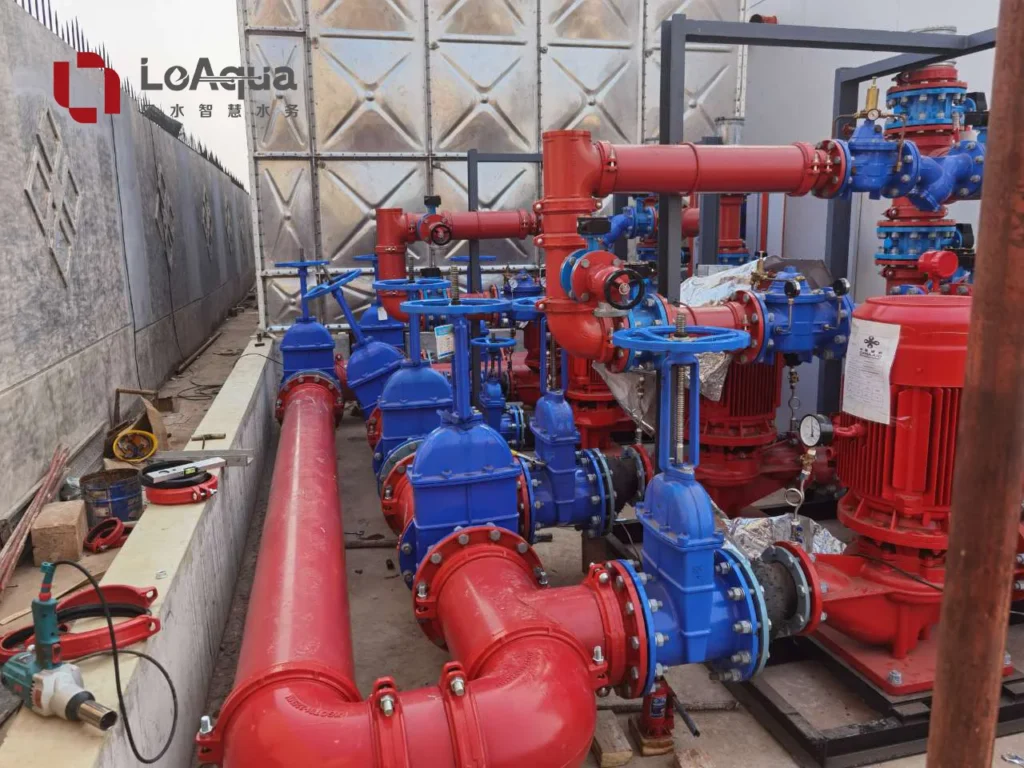
A pipe entering from the wrong direction may force several nozzles to be relocated. A small adjustment to a pump room layout can affect maintenance access. Even a staircase or cable tray added late in the project can change how installers move around the finished tank.
This is why drawing reviews rarely involve only one discipline.
Civil engineers, mechanical designers, plumbing contractors and project managers may all review different parts of the same drawing for different reasons.
Each team sees something slightly different.
The civil team may focus on the foundation dimensions.
The mechanical team may check pipe connections.
The installation team is often more interested in whether there is enough working space to assemble the tank safely.
No single review catches everything.
Instead, good projects rely on several reviews from different perspectives before production begins.
Some of the Most Important Changes Look Surprisingly Small
Not every drawing revision involves major structural changes.
In fact, some of the most valuable reviews result in adjustments that barely change the appearance of the drawing.
An inspection opening may move half a metre to improve maintenance access.
A nozzle may rotate slightly to simplify the pipe layout.
A ladder may be relocated because another piece of equipment now occupies the original position.
Individually, these changes appear minor.
Together, they make installation smoother and future maintenance much easier.
One reason experienced engineers avoid rushing through drawing reviews is that these small details rarely become obvious until the whole project is viewed as a complete system.
Looking at the tank alone is often not enough.
The drawing has to be understood within the context of the building, the pipework and the people who will eventually operate the facility.
A Drawing Is Reviewed More Than Once for a Reason
People sometimes ask why a drawing needs another review when it has already been approved by the design team.
The answer is simple.
Projects move.
A drawing that was accurate two weeks ago may no longer reflect what’s happening on site today.
Perhaps the civil contractor adjusted the foundation opening. Perhaps a pump supplier confirmed different connection dimensions. Sometimes the change is driven by the building itself rather than the tank.
None of these revisions suggests that the original drawing was wrong.
They simply reflect how construction projects develop. Information becomes clearer as more disciplines complete their work, and the water tank drawing evolves with it.
For that reason, experienced manufacturers rarely rely on a single review before production. They compare the latest revisions, check whether related drawings have changed, and confirm that everyone is working from the same version.
Most drawing errors are not technical mistakes.
They’re communication mistakes.
The Last Review Is Usually the Most Important One
There comes a point on every project when someone has to make a decision.
Not whether the drawing is perfect.
Whether it is ready.
Waiting forever isn’t an option. Manufacturing schedules, material deliveries and installation dates all depend on a drawing being released.
This final review is often less about design and more about confidence.
Has every major interface been confirmed?
Have the latest revisions been shared with everyone involved?
Is there anything that is still likely to change next week?
If the answer to those questions is no, the drawing is normally frozen for production.
That doesn’t mean no changes will ever happen again.
It means the project team has reached the stage where further changes are expected to be the exception rather than the rule.
Many successful projects are not built from perfect drawings.
They’re built from drawings that were reviewed carefully enough before manufacturing began.
A Good Drawing Makes Manufacturing Feel Ordinary
When production runs smoothly, people rarely talk about the drawing review.
They remember the factory delivering on time.
They remember the installation finishing as planned.
What often goes unnoticed is that those results usually started weeks earlier in the design office.
A well-reviewed drawing allows the production team to focus on manufacturing instead of asking questions that should already have been answered.
It allows installers to spend their time assembling the tank instead of adapting to unexpected changes.
It also reduces the number of decisions that have to be made under pressure once materials have already been delivered to site.
None of this makes the project more exciting.
It simply makes it more predictable.
And on large construction projects, predictability is often what keeps a schedule on track.
Final Thoughts
Every water tank eventually becomes a physical structure, but before that happens it exists as a series of decisions recorded on drawings.
Those drawings connect civil works, pipework, equipment layouts, maintenance access and manufacturing requirements into a single plan.
Taking the time to review them carefully is not an administrative exercise.
It is part of the engineering process.
At LeAqua, drawing reviews are treated as an opportunity to identify coordination issues before production begins. Once the project moves into manufacturing, every confirmed detail helps reduce uncertainty during fabrication, delivery and installation.
The best manufacturing process is not the one that starts first.
It is the one that starts with the right drawing.