Selecting a water storage system is no longer as simple as choosing a tank with sufficient capacity. Modern infrastructure projects require solutions that balance structural performance, long-term reliability, maintenance requirements, construction efficiency, and overall lifecycle value.
Among the many options available today, stainless steel water tanks and composite water tanks are two of the most frequently discussed solutions. Although they appear similar from the outside, their engineering concepts, structural composition, and typical applications can differ significantly.
One point should be clarified before making any comparison.
Throughout this article, the term Composite Water Tank refers specifically to a stainless steel composite water tank constructed with a food-grade stainless steel inner panel bonded to a hot-dip galvanized steel outer panel. It does not refer to FRP (Fiberglass Reinforced Plastic) or GRP water tanks, which represent an entirely different product category.
Understanding this distinction is important because many online articles use the word “composite” to describe FRP tanks, while engineering manufacturers may use the same term to describe composite metal structures. Comparing these two concepts without defining them often leads to confusion.
This guide explains the engineering principles behind both systems, compares their characteristics from a practical project perspective, and discusses where each solution may provide the greatest value.
Rather than identifying a universal “winner,” the objective is to help engineers, contractors, consultants, and project owners understand which solution is most appropriate for different operating conditions.
LeAqua develops both stainless steel water tank systems and stainless steel composite water tanks for municipal, commercial, industrial, and fire protection projects, allowing engineers to evaluate different solutions according to project requirements rather than a single design philosophy.
What Is a Stainless Steel Water Tank?
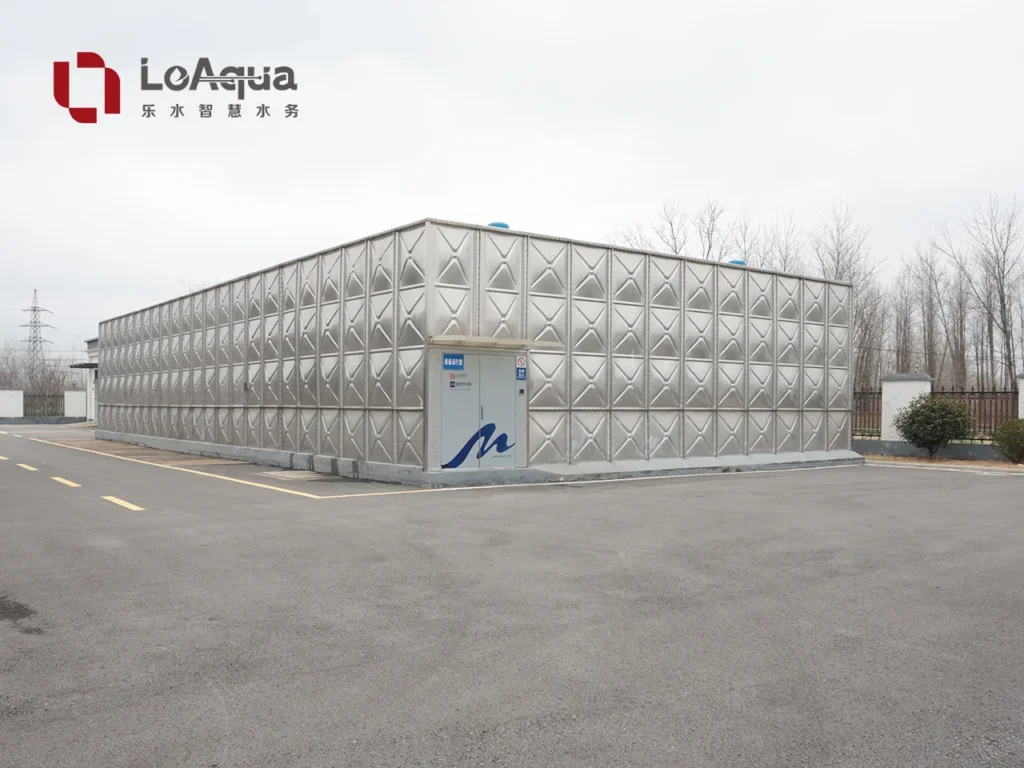
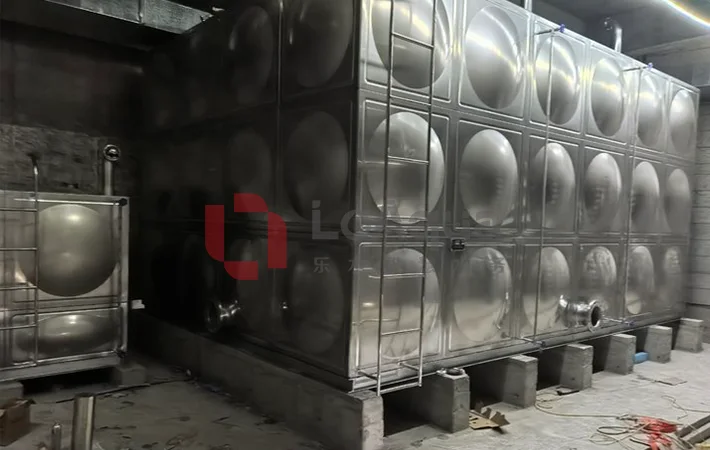
A stainless steel water tank is a water storage system manufactured primarily from stainless steel panels. Depending on project requirements, these tanks may use welded construction or modular bolted panel construction.
Modern stainless steel water tanks are widely adopted because they combine reliable structural performance with long service life and excellent suitability for potable water storage.
Depending on project requirements, stainless steel water tanks may be manufactured using materials such as SUS304, SUS316, or other grades selected according to water quality and environmental conditions.
Typical applications include:
-
Commercial buildings
-
Municipal water supply
-
Industrial facilities
-
Hospitals
-
Hotels
-
Schools
-
Fire protection systems
-
Pump stations
Although stainless steel is often associated with corrosion resistance, selecting a stainless steel water tank involves much more than material selection alone.
Engineers typically evaluate factors including:
-
Required storage capacity
-
Installation environment
-
Structural loading
-
Maintenance accessibility
-
Expected service life
-
Future operational requirements
These considerations determine whether welded or modular construction is more suitable and influence the overall engineering design of the water storage system.
Today, stainless steel water tanks have become one of the most widely accepted water storage solutions because they support a broad range of infrastructure applications while remaining adaptable to different project scales.
What Is a Composite Water Tank?
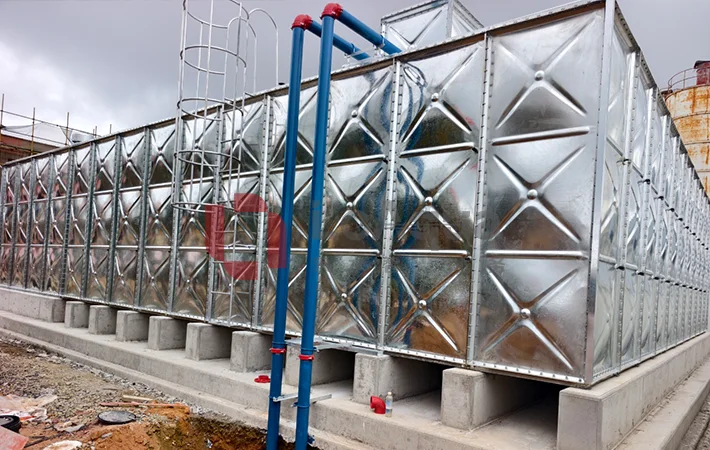
A Composite Water Tank, as discussed in this article, is an engineered water storage system that combines food-grade stainless steel with hot-dip galvanized structural steel to create a composite panel.
The inner surface, which comes into direct contact with stored water, is manufactured from stainless steel to help maintain water quality.
The outer structural layer is manufactured from hot-dip galvanized steel, providing additional structural strength while optimizing material utilization.
This engineering concept allows each material to perform the function for which it is best suited.
Rather than relying on a single material throughout the entire panel, the composite structure distributes performance responsibilities between the stainless steel liner and the galvanized structural layer.
Compared with conventional single-material panels, this approach may offer advantages in projects where structural performance, economic efficiency, and long-term engineering value must be considered together.
It is important to emphasize that this type of composite construction is fundamentally different from FRP or GRP water tanks.
While both products may use the word “composite,” their materials, manufacturing processes, structural behavior, and engineering applications differ substantially.
LeAqua’s composite water tank solutions are based on this stainless steel–galvanized steel composite structure and are designed for modular assembly across a wide range of commercial, municipal, industrial, and infrastructure projects.
Why Were Composite Water Tanks Developed?
The development of composite water tanks reflects a broader trend in modern engineering: using multiple materials strategically rather than expecting a single material to satisfy every design objective.
As infrastructure projects became larger and more demanding, engineers increasingly sought solutions that could balance several requirements simultaneously, including structural strength, operational reliability, construction efficiency, and lifecycle economics.
Traditional material selection often involved trade-offs.
Using stainless steel throughout the entire structure provides excellent durability and hygienic performance but may increase overall material costs for certain projects.
Conversely, relying entirely on structural steel may provide high strength but requires additional consideration for the surfaces that remain in contact with stored water.
Composite engineering addresses this challenge by assigning different roles to different materials.
In a stainless steel composite water tank, the stainless steel inner layer protects water quality, while the galvanized structural layer contributes to the overall rigidity and load-bearing capability of the panel.
This design philosophy is similar to many modern engineering systems, where each material is selected according to its functional advantages rather than applying one material uniformly throughout the structure.
For many infrastructure projects, the objective is not simply to build a water tank but to develop a water storage system that achieves an effective balance between performance, practicality, and long-term operational value.
Understanding this engineering philosophy provides the foundation for comparing composite water tanks with conventional stainless steel water tanks in greater detail, which will be explored in the following sections.
Structural Differences Between Composite Water Tanks and Stainless Steel Water Tanks
The most significant difference between a composite water tank and a stainless steel water tank is not simply the material itself—it is the engineering philosophy behind the structure.
Although both systems are designed to safely store water over many years, they achieve this objective using different structural approaches.
A conventional stainless steel water tank typically relies on stainless steel panels as both the water-contact material and the primary structural component. Depending on the project, these panels may be welded together or connected through modular bolted construction.
A composite water tank follows a different engineering concept.
Instead of assigning every function to a single material, the composite panel separates responsibilities between two materials.
The stainless steel inner layer serves as the hygienic surface that comes into direct contact with water, while the hot-dip galvanized steel outer layer contributes to structural rigidity and mechanical strength.
Rather than competing with one another, the two materials work together as an integrated structural system.
This approach reflects a broader engineering principle that has become increasingly common in modern infrastructure—selecting different materials according to their individual performance characteristics instead of expecting one material to optimize every requirement.
For engineers, the structural difference is therefore not simply about thickness or weight, but about how loads are transferred throughout the entire water tank during years of operation.
Project requirements ultimately determine which structural concept is more appropriate.
Material Performance Comparison
Material selection directly influences how a water storage system performs throughout its service life.
Both stainless steel water tanks and composite water tanks use stainless steel as the water-contact surface, allowing both systems to provide suitable conditions for potable water storage when designed and manufactured correctly.
The primary distinction lies in how structural performance is achieved.
In a stainless steel water tank, the stainless steel panel performs both the hygienic and structural functions.
In a composite water tank, these functions are divided.
The stainless steel inner surface focuses on protecting stored water, while the galvanized outer layer contributes additional structural support.
This separation allows each material to perform the role for which it is best suited.
From an engineering perspective, neither concept should automatically be considered superior.
Instead, engineers evaluate several factors, including:
-
Project budget
-
Structural loading
-
Installation conditions
-
Water quality
-
Expected service environment
-
Design service life
Material selection therefore becomes part of a broader engineering optimization process rather than a simple comparison of material properties.
Material Comparison
| Feature | Stainless Steel Tank | Composite Tank |
| Inner Surface | SUS304/SUS316 | SUS304/SUS316 |
| Outer Layer | Stainless Steel | HDG Steel |
| Typical Structure | Welded/Bolted | Modular |
| Water Contact | Stainless Steel | Stainless Steel |
Comparing Service Life and Long-Term Performance
Many buyers ask a simple question:
Which water tank lasts longer?
In reality, service life depends on much more than the material listed in the specification.
Long-term performance is influenced by several interacting factors, including:
-
Engineering design
-
Manufacturing quality
-
Structural calculations
-
Installation quality
-
Water conditions
-
Operating environment
-
Preventive maintenance
A properly engineered stainless steel water tank can provide decades of reliable operation under appropriate service conditions.
Likewise, a properly designed composite water tank is intended to deliver long-term structural stability by combining stainless steel with galvanized structural reinforcement.
Rather than focusing solely on theoretical service life, many infrastructure owners now evaluate overall operational reliability throughout the lifecycle of the project.
This broader perspective better reflects how modern infrastructure assets are managed.
Maintenance Considerations
Maintenance requirements should be considered during the earliest stages of project planning rather than after installation.
Regardless of tank type, routine inspection remains essential for maintaining long-term performance.
Typical maintenance activities include:
-
Internal inspection
-
Cleaning
-
Water quality monitoring
-
Inspection of structural connections
-
Verification of accessories and fittings
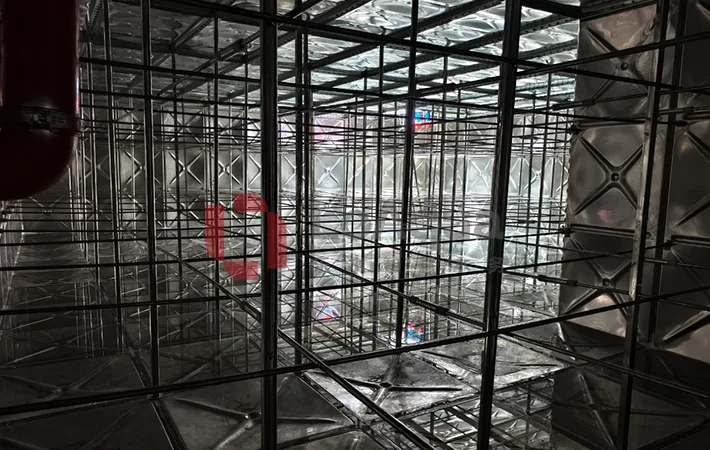
Both stainless steel water tanks and composite water tanks should be designed to provide practical access for inspection and maintenance personnel.
Good engineering is not only about building a strong structure—it is also about ensuring that the structure can be inspected and maintained efficiently throughout its operational life.
For this reason, maintenance accessibility has become an increasingly important consideration in modern infrastructure projects.
LeAqua incorporates maintainability into the engineering design process so that long-term operation remains practical after installation.
Installation and Construction Considerations
Installation methods vary according to project size, location, and construction schedule.
Both stainless steel water tanks and composite water tanks can be manufactured using modular panel systems, allowing components to be transported separately before assembly on site.
This modular approach provides flexibility for projects where transportation or installation space is limited.
Examples include:
-
High-rise buildings
-
Equipment rooms
-
Underground installations
-
Industrial facilities
-
Municipal infrastructure
Because panels are assembled after delivery, modular systems can often accommodate installation environments that would be difficult for large prefabricated structures.
However, successful installation depends not only on the tank itself but also on foundation preparation, structural support, construction sequencing, and quality control during assembly.
Experienced engineering teams evaluate these factors together to ensure that the completed water storage system performs as intended throughout its service life.
For this reason, selecting an experienced manufacturer is often as important as selecting the tank design itself.
LeAqua supports projects through engineering consultation, structural design, manufacturing, and technical assistance to help ensure that each water storage solution is implemented according to project requirements.
When Should You Choose a Stainless Steel Water Tank?
A stainless steel water tank is often selected when projects place the highest priority on water hygiene, long-term durability, and dependable performance across a wide range of operating environments.
Because the entire water-contact structure is manufactured from stainless steel, these systems have become a widely accepted solution for potable water storage, commercial developments, hospitals, hotels, municipal facilities, and industrial infrastructure.
Engineers may consider a stainless steel water tank when a project requires:
-
High standards for water quality
-
Long-term operational reliability
-
Proven engineering performance
-
Flexible installation options
-
Compatibility with modular or welded construction
Rather than viewing stainless steel as a premium material alone, many project teams evaluate it as a long-term infrastructure investment capable of supporting reliable water storage throughout the facility’s service life.
Ultimately, the most appropriate solution depends on engineering requirements rather than material preference.
When Is a Composite Water Tank the Better Engineering Solution?
A composite water tank is designed around a different engineering philosophy.
Instead of relying on one material to perform every function, the composite structure combines stainless steel and hot-dip galvanized steel so that each material contributes according to its own strengths.
For many infrastructure projects, this creates an effective balance between structural performance and practical engineering requirements.
Composite water tanks are frequently considered when projects require:
-
Large-capacity water storage
-
Efficient structural performance
-
Modular construction
-
Practical lifecycle planning
-
Reliable long-term operation
Rather than replacing stainless steel water tanks, composite water tanks expand the range of engineering options available to project owners.
The objective is not to identify one universally superior solution but to select the design that best matches the operational goals of the project.
This is why experienced engineers typically begin by evaluating project requirements before selecting the tank configuration.
Common Misconceptions About Composite Water Tanks
Because the term “composite” is widely used across different industries, misunderstandings are common.
Misconception 1:
A composite water tank is the same as an FRP water tank.
This is incorrect.
The composite water tank discussed in this article is a stainless steel composite structure consisting of a stainless steel inner liner and a hot-dip galvanized steel outer structural layer.
Its engineering principles differ completely from FRP or GRP tanks.
Misconception 2:
Composite water tanks are simply lower-cost stainless steel tanks.
Not necessarily.
Composite engineering is intended to optimize structural performance by assigning different functions to different materials.
Its purpose is engineering optimization—not simply material reduction.
Misconception 3:
One solution is always better than the other.
Infrastructure projects vary significantly.
Water quality requirements, installation conditions, loading requirements, maintenance strategies, and project budgets all influence the appropriate engineering solution.
Professional design should always be based on project requirements rather than generalized comparisons.
Engineering Recommendations from LeAqua
Every water storage project is different.
Rather than recommending a single product for every application, LeAqua approaches engineering from a project-oriented perspective.
During system design, engineers typically evaluate:
-
Required storage capacity
-
Water quality objectives
-
Installation environment
-
Structural loading conditions
-
Future maintenance accessibility
-
Long-term operational planning
-
Construction schedule
-
Overall lifecycle considerations
These engineering factors help determine whether a stainless steel water tank or a composite water tank provides the most suitable solution.
The goal is not simply to manufacture a water tank but to develop a reliable water storage system that supports long-term infrastructure performance.

Frequently Asked Questions
Is a composite water tank the same as an FRP tank?
No.
In this article, a composite water tank refers to a stainless steel composite panel consisting of a stainless steel inner surface and a hot-dip galvanized steel structural outer layer. It is a different product from FRP or GRP water tanks.
Which tank is better for potable water storage?
Both stainless steel water tanks and stainless steel composite water tanks can be designed for potable water applications when appropriate materials and engineering standards are applied.
The final selection depends on project requirements rather than a single material characteristic.
Can both systems be installed using modular construction?
Yes.
Depending on project specifications, both stainless steel water tanks and composite water tanks can utilize modular panel construction for transportation and on-site assembly.
Which solution requires less maintenance?
Routine inspection and preventive maintenance remain important for both systems.
Long-term performance depends on engineering quality, installation practices, operating conditions, and regular maintenance rather than tank type alone.
How should engineers choose between the two?
The decision should be based on engineering evaluation rather than product preference.
Factors such as water quality, structural requirements, installation conditions, lifecycle expectations, maintenance planning, and project budget should all be considered together.
Conclusion
Comparing a composite water tank with a stainless steel water tank is not about identifying a universal winner.
Each system has been developed to address different engineering objectives, and each offers advantages under appropriate project conditions.
The most successful infrastructure projects begin by understanding operational requirements before selecting the most suitable water storage solution.
By evaluating structural design, material performance, lifecycle considerations, and long-term maintenance together, engineers can make informed decisions that support reliable water storage for many years.
LeAqua develops both stainless steel water tanks and stainless steel composite water tanks based on practical engineering principles, helping project owners select solutions that align with real project requirements rather than one-size-fits-all recommendations.